|
Window Treatments home > Site Information Center > Types of Blinds Types of BlindsClick
here to see our selection of Types of Blinds.
With blinds, two factors differentiate the many types available: the material used to make the slats and the size of the slats. Most blind manufacturers also offer a "blackout" feature. The slats are overlapped so that no light comes in thru the cord holes · Aluminum Blinds Lightweight vinyl blinds are the least expensive blind available, but can be flimsy. Aluminum blinds, a moderate step up in price, are a better choice. They come in 1/2-inch, 1-inch, and 2-inch sized slats, as many as 100 colors, and some manufacturers offer different finishes including metallic, hammered, brushed, and a leather-like soft suede. The two-inch slats generally provide better sun control, and because there are fewer of them, they are less intrusive to the view outside. · Faux wood blinds The next step up in price is the wood look-alike blinds, usually called "faux wood." Their one and two-inch sized slats are thick and look like the real thing to everyone but a window treatments expert. The wood look-alikes are either a wood-polymer mix or 100 percent polymer. Faux wood blinds are favored by many interior designers because they are easy to clean, an advantage in a kitchen, and they don’t warp, fade or crack, a great advantage in a room with high humidity such as a bathroom. Wood and faux wood blinds will definitely dress up a room, but
if the window is large, they can be cumbersome and heavy to raise.
These give a room a more finished look, and because you can open
the top half for light and air while keeping the bottom part closed,
offer more options for sun control and privacy than a regular blind.
|

 So
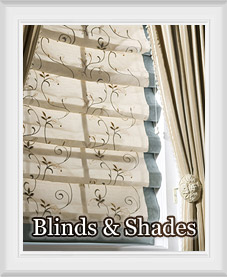
what’s the difference between a blind and a shade? Blinds
afford sun control and a view while most shades simply block out
the sun or not.
So
what’s the difference between a blind and a shade? Blinds
afford sun control and a view while most shades simply block out
the sun or not.Client Testimonials continued

Thank you so much! I will definitely use your company again and will recommend you to my friends and family. What a great price for quality treatments. I've had a great experience! Thanks for your quick responses, patience and excellent customer service. Will be Back Again!

I ordered an extended length drapery rod and finials from you about a month ago. Just wanted to let you know that I was very happy with how easy your site makes it to order the length I needed. I love the finish of the rod, and mostly I loved the price. I looked at a lot of websites and didn't find anything that compared to what Best Window Treatments had to offer. Wanted to be sure and let you know that I'm 110% satisfied with the quality and the service. Thank you.

Thanks. I will definitely recommend your company to all my interior designer friends here in West Palm Beach. I have a new home 5,100 sq.ft., with lots of windows. My friend who is an interior designer is working on my home and she loved the curtains I ordered from you. All of this to say, I am very happy you worked with me on this and will definitely be advertising on your behalf.
These curtains are so perfect. I'm using these as 3/4 length curtains in my bedroom but I would love to have them as full curtains in the living room, family room and den. I cannot begin to tell you how thrilled I am about the quality, material, construction and appearance. Thank you, thank you, thank you!
I just received my order today order and I am absolutely elated. I never ordered from your company before and was very apprehensive about just what I was getting.. Your color pictures were acurate. The color was exactly as stated and the workmanship is very impressive. I would recommend your company to any one who is looking for window treatments. Thank you for your prompt service because I was very anxious, both because I wanted to get them up and because I didn't know what to expect. Above Expectations!!
Opening Hours
We have email representatives available 9am - 8pm EST, or call us during hours below.
- Mondays-Fridays: 9AM to 5PM EST
- We often have extended hours support, please leave a voicemail and we will get back with you as soon as possible.
We have the best selection of Types of Blinds at the lowest prices!
Related Information:
|